
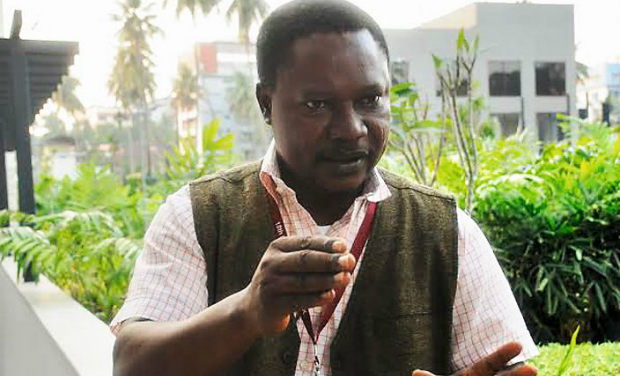
Niji Akanni is a Nigerian dramatist, playwright, screenwriter, producer, director, filmmaker, and university lecturer. With academic and professional degrees from Obafemi Awolowo University, Ile Ife, the University of Ibadan and the Film and Television Institute of India, he has scripted, co-scripted and directed many films and won several awards in Nigeria and abroad. He remains one of the few notable professionals in Nigeria, who navigates the academic and professional worlds with ease. Niji Akanni spoke with Kolawole Olaiya of Nollywood In Review in Ibadan, Nigeria, on various topics early this year. It was a delightful discussion on theory and practice, the challenges faced by current students and teachers, and the representations of women in Nollywood movies. He also spoke extensively on skits, with particular focus on Mr. Macaroni and other comedians. The issues discussed here should be interest to students and scholars of Nollywood movies.

Nollywood In Review: Thanks for creating time to speak with me. You have worked on different shows. Significantly, you have worked on comic shows – Papa Ajasco, is one good example. So, let’s kick up this interview with what you think about skits.
Niji Akanni: They are mostly satires. But unlike the classic form of satire, most satirical skits currently in the Nigerian media space don’t quite get the point that beyond laughter, satires are also used to x-ray or analyze the ills of the society. So, the skits don’t do enough – they lampoon but only very few do enough of critical analysis.
Nollywood In Review: Is there any skit or skit maker you find their work unique? Is there a skit maker that addresses issues in the way you like?
Niji Akanni: Among the skit makers, Macaroni is the most politically conscious. He self-consciously presents his skits and uses it to address social issues. He is the best, in my own reckoning. Most of Macaroni’s so-called competitors are into either slapstick or into bland entertainment. There were other comedians before him that were not interested in the political implication of their works. For example, I have worked with Wale Adenuga and directed Papa Ajasco. What Chief Adenuga does is not even lampoon. It’s pure humor. It’s entertainment; its slapstick comedy. He is a master of that form and deserves a separate study of his ingenuity. In fact, he aptly self-styled himself the ‘humor merchant’. He is an entertainer. He says that his duty is not to make people think but laugh and ‘forget’ their sorrows. On the contrary, Macaroni in a way, is a comedian in the mold of Baba Sala. Not only in the humor-tone aspect of his work, but also in the subtly critical message and resonance of his shows. Most of the inheritors of Baba Sala comedy watered the message and concentrated fully on the entertainment quotient. To them, ‘it’s all about entertainment’, to quote the slogan of a popular Nigerian television channel.
Nollywood In Review: What are your thoughts on Skits and Comedy, generally speaking?
Niji Akanni: Most of the skit makers are interested in creating humorous shows. They want to make people laugh. They do not focus on comedy as a means of changing things. I think largely what drives their shows is making people laugh and making money. To use the current expression, they all want to ‘blow’. In other words, the more likes, the more comments, and the more followership they get on social media is their measure of success. What is now common is the intense commercialization of comedy. But this is different with Mr. Macaroni. For him, I think his concern is more of ‘who am I touching?’. And who he is touching is very specific and intentional: he is touching his generation. He is not bothered about speaking to people like you and I – the older generation. He believes that people like us have expired! That we have nothing to contribute. Not just that we are old, but that we are useless. We are useless to this generation.
Nollywood In Review: Really? How so?
Niji Akanni: He believes that no matter how good we are individually, we – members of the older generations – cannot touch the spirit of the current generation. I’ve known him for quite a while: he was a professional colleague, then, he formally became my student at the university, then, we reverted to being colleagues. When he began to grow his skit, I knew exactly where he was headed. He wanted to stay within the spirit of this generation. And what is that spirit? The spirit of rebellion. Spirit of change. Spirit of critique. All that stays and shines brilliantly in his work. His work deserves serious study. I am confident that that if you would only concentrate on Macaroni’s skits, the work has much integrity and could be a pathfinder in scholarship of the comic genre in Nigeria.

Nollywood In Review: The Skit form – in its various manifestations, is pervasive. There is a distinctness to the way it is utilized in Nigeria. It has metamorphosed into a genre that appropriates advertisement into its form. While it is true that there are occasional advert breaks in between some skits, most skits appropriate the message. In many cases the skits are about a product. There’s something I have noticed about Mr. Macaroni. He works with different people. He is unselfish.
Niji Akanni: I can hazard some guesses to explain his tendency to assist people. He didn’t start big or with a bang. Mr. Macaroni is not a new creation. He created it long before going to the university. His mother owns schools – Nursery, Primary and Secondary schools. He grew the Mr. Macaroni persona from his interactions with the students in those schools, entertaining the kids and their parents during the several social or sports fiestas interludes in the school calendar. The positive response of those pupils and their parents must have greatly encouraged the development of the Mr Macaroni identity. Also, in the university, he was very popular on the Redeemers University campus at Ede, organizing various social events and plying his quite prodigious acting talent in the Department of Theatre. Before and immediately after his university education, he had worked patiently and steadily as a very reliable actor in mainstream Nollywood, especially the Yoruba cinema sector. One of the lesser-known Yoruba artists – Sunny Ali – was his ‘boss’ and mentor. In Yoruba Nollywood, you must belong to a recognized faction of the industry. There is need for someone that can vouch for you – someone to be consulted if anything happens, someone you can be traced to. He belonged to the Odunfa Caucus and he chose Ali as his ‘Oga’. When he became successful, the first thing he did was to start paying back everyone that helped his climb. He invited them to participate in his skits. He has worked with most of his colleagues in the industry, including many of his classmates. Almost all of these people also run their own visible acting, comedy or skit-making careers. He pays everyone well, far beyond industry rates. He is not selfish. But then, including so many of these artists in his shows is also a mark of his business sense. This is because featuring them is a way of attracting their fan base, which makes business sense. Finally, there is also a utility factor in working with these diverse stars. Macaroni has a message to pass. He knows that by coopting the artistes’ fan-base to widen his own audience reach, he is touching more people with his message. That’s how smart he is: a businessman, a humanist and an activist all rolled into one bundle of prolific energy.
Nollywood In Review: So, his Skits are guided by his view of life.
Niji Akanni: Definitely. He was president of the student union during his time at the Redeemers University. He had serious issues with the university administration because he was uncompromising and would not condone whatever he perceived as ‘unjust’ in the school system. He would not accept certain things that people saw as ‘commonsense’ or ‘commonplace’. He would question it. But he wasn’t militant. A militant artist cannot succeed as he is doing. Very few militant artists in the world succeeds. He is confrontational but not militant. His tactics are described as ‘militant’ when reactionary forces, as it were, begin to attack him. Even the confrontational elements in himself and his art is not that he points fingers. His weapon is classic satire, through lampoon. So, he was not confrontational when he was the Redeemer University Students Association president, but he would question everything. He would make his point and let them know that he did not agree with their policies. If you insist on lording your points over him, he will let you know that he’s yielding only because you have more power at that point in time. But he will let you know that it is wrong. He was not allowed to complete his academic programme within the scheduled time. I think he waged various battles – including legal action at some point – with the University administration for a couple of years before he was finally allowed to graduate.
Macaroni has erected a structure that now functions with minimum contributions from him. He’s very strategic. Mr. Macaroni has become not just a brand; he is a cultural icon. He is a brand for advertisers. The same way Baba Sala was an icon outside of Mr. Adejumo. But unlike Baba Sala, Macaroni appears inseparable from Debo, the person. Yes, Debo, as a person, is not too far from Mr. Macaroni in some ways. The comic masters who came before him, they separated themselves from their stage or screen personas. The difference is very clear between the comic characters and the human being behind their creation. Aluwe is a case in point. And Baba Sala. And Charlie Chaplin. But Macaroni is Macaroni everywhere. He is a fount of bubbly life. He is outgoing and personable. He lavishly gives out money to people in real life, even total strangers. He does so to his male and female friends and ex-classmates. He once sent a huge amount of money to a female ex-classmate because he learnt that she was going through some hard times. The other masters of comedy I mentioned, were, in history, almost complete opposites of their public avatars.
Nollywood in Review: You are an academic but also a Nollywood practitioner. Tell me about your crop of students – are they planning to do theatre or go into acting and filmmaking?
Niji Akanni: Everyone wants to go into Nollywood. Except for a few. Most students in our department of theatre had done some courses that involve cultural studies in secondary school. The stage is usually their first contact with theatre. My experience is that maybe about five percent get into the university, yearning to do stage/theatre. By the time they get to 400 level, they would have reduced to one per cent. Most current students do not even associate theater with film at all. They think Nollywood is totally different from stage.
Nollywood in Review: How come?
Niji Akanni: Because the dominant narrative of Nollywood has omitted the theatrical percussors from Nigerian film history. The popular narrative of Nollywood dates the practice from 1992, with Living in Bondage. This narrative forgets that the nascent Nigerian film industry was dominated by the Yorubas coming from travelling theatre tradition, through Atoka photoplay magazine, to television drama, the celluloid and optical reversal films and analogue video productions. So, the crop of theater students we have now come into the university and remain there with that incomplete base of the knowledge of Nigerian theatre. They cannot relate it too Nollywood at all. To them, Nollywood is like Hollywood; it came from the sky! When they come into the department, they want to do theatre on stage – to become another Soyinka, Rotimi and Zulu Sofola, and others. But by the time they get to 400 level, all of them want to go to Nollywood practice. This is also largely because current professional theatre practice in Nigeria cannot meet the students’ financial needs in their adult life outside the university. Even in Ibadan, which used to be the center of the performing arts, live theatre is fast becoming a rarity outside the university. Only some very young die-hard enthusiasts keep theatre alive in that city. Even those ones must supplement their income with other sources like appearance on TV films and serials, etc. They do not see themselves earning a living in the theater, and, truth be told, they can’t! Everything is Nollywood. I teach directing. All my directing students want to learn film, not theatre. The make-up students want to practice in Nollywood. Music students want to do soundtrack in Nollywood.
Nollywood in Review: Even in Ife?
Niji Akanni: At the University of Ife, I would say the older generation of teachers and instructors are still trying – maybe more than elsewhere in Nigeria – to inculcate those old-fashion skills of stage performance because they (teachers) have a tradition to uphold. But then, my daughter is in theater. She is currently in 300-level at the Dramatic Arts department at OAU. She loves the theatre deeply. But when she comes home and we talk; I know that her mind is not going towards earning a living on the stage.
Nollywood in Review: If students are this interested in Nollywood, how much of Nigerian film history do they know? Do you teach your students Nigerian film history? They need to be grounded in the history of the theatre and Film.
Niji Akanni: We teach the theories of theatre and the theory of liberal arts. But I don’t think we in the academia have responded adequately to the fragmented history of the theatre and film in Nigeria. We have not responded to that dislocation, or maybe it’s just that we have not done enough to correct that dislocation. To be sure, some of us try to let our students realize that they should not listen to the mainstream narrative of Nollywood; the disjointed history of Nollywood; that it goes beyond that. But I’m yet to see a formal curriculum of teaching in any theatre department structured to intentionally rectify this disconnect. Maybe it does exist and I’m not aware of such. But as you said just now, it is highly important to let the students know the connection between their theories of theater, their own indigenous theatre history and how these two factors can influence their practice in Nollywood, since that’s where they are headed. It is our duty to let them know the source of what is happening now and what they will be doing in their own career.
Nollywood in Review: Yes, it is important. If you know where you are coming from it may inform your own creativity. Knowing the different stages of its development certainly helps you to respect the form. Maybe if there is a curriculum that includes classical writing, for instance, don’t you think that would help? Because if your students are asked to study Hamlet in Shakespearian English, they would do it.
Niji Akanni: Yes, we need to develop a curriculum that addresses this situation. A course that specifically teaches the authentic history of Nollywood would be a good one. A course that is designed for teaching, let’s say, Theatre Continuities. Here, you can trace the history of Nollywood. Nollywood did not start with Living in Bondage. It didn’t even start with the counter narratives. I told my third year directing students to read Amos Tutuola. I gave them two books by the master. They came back and told me they cannot read it. I said why? They said because of the English. I then asked them what about the English? They said it was different. I asked: “What do you think was happening to Amos Tutuola as he wrote that ‘different’ English”? They said they didn’t know. I made them realize that what Amos Tutuola did was improvisation. The Master was improvising on what he knew. He was not thinking and intellectualizing anything. He was pouring out everything as they occurred in his imagination, in the language or vocabulary that came easiest to him, not pausing to refine anything. That’s the Master’s oral literature background working seamlessly through him as he wrote. It was like someone sitting down and telling a story to a paper!
Nollywood in Review: It was authentic.
Niji Akanni: Yes. He was not ‘forming’ English. He was writing from his heart. I told my students; ‘If I ask you to go and write a Nollywood film, because that is what you want to go and practice, you mind will instantly be looking for an ‘appropriate’ formula to use’. Because they know the structure of Nollywood movies. Because they know the form. They know how to compartmentalize everything. They know the qualities of a good character, etc. They can’t read Tutuola’s novel because they have been schooled to believe that writing must be in a certain way. When you go to Nollywood, that is what you are going to practice. Film is art. Creativity is not supposed to be formulaic. It is what is in your heart that you must pour out. You are quite right, Prof, academia has not responded to this issue. We have not. We responded to it only when we go to seminars, where we note that most mainstream Nollywood films look the same.
Nollywood in Review: But how do you do that? How do you groom those who are coming not to use formula creativity? So, how much of scriptwriting for film and television do you teach your students?
Niji Akanni: I think the kind and scope of scriptwriting that is traditionally taught in theatre and film departments, is very minimal. But this is about to change. That is because there is this process of unbundling currently going on in the departments of theatre, film and media studies in Nigeria. Until that unbundling is implemented and test run for the at least four to five years, we cannot begin to see the results of a changed curriculum for scriptwriting for film and television. Right now, there is no space for teaching that comprehensive syllabus that produces fully competent scriptwriters in our universities. Students in most theatre departments take, maybe, two screenwriting courses before they graduate. This is because they still must learn scriptwriting for theatre – and they only have four years. Lastly, they take NUC approved courses for the first two years. It is only in the last two years that they begin to specialize. In most universities, the fourth year is the year of specialization. Until film is studied as film, that is when you begin to see an increase in the scope and efficiency of screenwriting courses. There is too much distraction right now – we are lumping theatre and film under the same curriculum. Things are changing, but it is very slow. The second thing is that even after the unbundling, you are not sure what to teach: filmmaking or film studies? This must be defined clearly.
Nollywood in Review: But do we have competent teachers in this field?
Niji Akanni: The new crop of younger film professionals know that they cannot learn everything they need to know from the university. They go out of the university system to study and acquire the needed skills.
Nollywood in Review: Are there schools outside the university setting around that can give them the needed skills?
Niji Akanni: Yes, there are. Almost all the major actors, from all sectors of Nollywood, run film schools. Such schools may look and run like mushroom cottage industries, but they do teach hands-on skill acquisition in filmmaking. Their curriculum may be wishy-washy, their structure may not be efficient, their teaching methodology may be awful, but the fact that they concentrate on hands-on teaching enables the younger ones to learn the tricks of the trade firsthand and in practice. That is why when you see that the young filmmakers graduating from the Nigerian National Film Institute (NFI) are much more efficient than regular university graduates. The National Film Institute is teaching filmmaking, it is not teaching film studies. Our universities run film studies programs, so we turn out theorists, not practitioners.
Nollywood in Review: And practice matters a lot.
Niji Akanni: It does. To even become a proficient academic in any field, you must be a passionate practitioner in that filed.
Nollywood in Review: Yes, it is a way of life.
Niji Akanni: Yes, if you choose to be an academic, it requires total commitment. I want to train practitioners and academics. The structure that is helping us to unbundle now is good. Gradually we will get to the point that gives us the clear option of producing film scholars or filmmakers.
Nollywood in Review: You are a practitioner and an academic. How do you combine both? How manage it successfully?
Niji Akanni: I came into full-time academia only five years ago. Before then, I was, for about ten years, a visiting lecturer in some schools while I was practicing. The bulk of my experience has been in practice. Now that I’m fully into academia, lack of time has affected my practice. I do more of scriptwriting now. The little production I have done as an academic has been more of documentaries. Unlike feature films, the documentary does not usually require a sustained time on the field. If I spend two weeks shooting a documentary, I can spend the next ten months to edit it, shaping it to my taste. In a dramatic film, you can’t do that. You shoot it in two weeks, and you spend the next few months editing it. But my career path has its benefits. For my current students, I think they have an advantage. Having been a practitioner for decades, now, I am back into scholarship, I can equip my students more proficiently for life on the field. Now, I can show them my films and my scripts as concrete examples of the abstract theories and concepts I teach from books that they also read. That would enable them to see the concordance and disjoints between theory and practice. Having seen what films I produced from scripts written by me and others, if they have questions, I can answer them eloquently. If I want to recommend, I will rather have a practitioner become a teacher than the other way round.
Nollywood in Review: I agree with you. That was my experience. I worked in NTA as a producer and director for years. I taught scriptwriting and television production and directing at the Nigerian Television College, Jos. From there I went back into full academics. What motivated you to change from the industry to the academics?
Niji Akanni: Two things. The primary motivation was a sudden reality check that I needed to get a PhD. It happened that I applied to a film funding agency to do a documentary series on the resuscitation of Isese (indigenous Yoruba religion and spirituality). My conception and design of the project was close to what Ali Mazrui did in his documentary on pan-African cultural heritage. I was told very clearly that there was nothing wrong with the documentary proposal: that it was a brilliant idea: but that they will only give that kind of funding to a PhD holder. Basically, they told me that I was not competent enough to handle such a big project. I have MA and MFA in film. But because I didn’t have a PhD, I lost the chance of working on something related and highly beneficial to my culture. That’s what did it for me. The following year, I started a doctoral program at the University of Ibadan but couldn’t complete it because I was in practice. A doctorate is not something you do piecemeal, you need to commit time to it. My children were growing up then, as well, so I didn’t have the time and resources to complete it. But now that they have grown, I am back on it. So, I left full-time practice for the academia because I can pursue the PhD better, faster from the inside, as it were. Secondly, I opted for academia because I thought that as we grow older, those that have looked up to us, those who want to learn from us can benefit more if we teach from a more structured platform like a university system rather than from the field of practice where they can only learn as Interns and/or Apprentices. If I begin to teach and they can participate in my ongoing practical projects; they’ve got a double-edged advantage. As a tenured teacher, every year I turn out a new set of students that has undergone four years of teaching and sustained professional guidance under my wings. So, technically, every year, I’m building a new generation into the practice. That’s a very satisfying thought.
Nollywood in Review: You mentioned that you were interested in the documentary genre. Which I found relevant. Why is the genre not developed in Nigeria?
Niji Akanni: Because there’s little or no space in our broadcast and screen culture for the documentary form.
Nollywood In Review: But Nigerians watch the National Geographic Channel and other foreign documentary program channels.
Niji Akanni: And even for those channels, too, what is the scope of their audience in Nigeria? Such audience demographic are the elites. Our broadcast and screen space are more oriented towards entertainment, not discourse. Documentary is largely discourse. It is not like Telemundo, or other movie channels. It’s different.
Nollywood In Review: But documentary can also be entertaining.
Niji Akanni: Even Nollywood films that tend to be discursive don’t do well. Once you bring elements of discourse into the narrative, it becomes problematic because our audience simply wants to be entertained. If they can turn off from a discursive entertainment film, imagine what they would do to a documentary film. But the Yoruba documentary I conceived; I know that it has its audience. Because at least core Isese people, both at home and abroad will access it. They will watch it.
Nollywood In Review: But there are some topics that have ready-made audiences.
Niji Akanni: Yes. They have niche audience. There is no doubt about that. But the fact remains that the niche audience cannot sustain the commercial viability of such projects.
Nollywood In Review: Don’t you think that there may be people who are ready to invest in such projects.
Niji Akanni: You cannot raise investment money to for a documentary in Nigeria. The best you can get are grants. In Nigeria there is virtually nothing like that. I was trying to get a consortium of people to fund my Isese documentary series. My consultant told me point blank that if I scaled down the project, they may give me some money. But the money would not be enough for the kind of project I wanted to do. So, I turned it down. I was looking to do a project that would take about three years. I was going to follow this story from Oyo to Osun, Benin, to Benin Republic and to Brazil and other Yoruba diasporic cultures around the world. The money proposed won’t be enough.
Nollywood In Review: What do you think about the portrayal of women in Nollywood films?
Niji: Culture and social orientation affect the way women are portrayed in Nollywood movies. My interactions with my students reflect this in an interesting way. When they get to doing practical work, you find them regurgitating the same problems they complain about in our extant films. They tell the same stories that repress, misrepresent and downright insult women. There are very subtle factors that go into this. One is the cultural mindset about ‘the place of women’. Almost all our cultural institutions teach it; they reinforce it. Christianity will tell you that the place of women is in the home. ‘The husband is the head of the wife.’ Culturally, phrases like this make women refer to the husband as their ‘crown’. Then there are sayings like ‘virginity is the honor of a woman’. This is a very loaded statement! It even influences the notion of power in gender relations. So, how do men exercise power over women? By taking their virginity. When society has conditioned the mind to see virginity as the honor of women. How do you debase her? Exercise your power over her! You do so by taking her virginity (‘honor’) willingly or by force. It is this culture that comes out when they want to write a script. They begin to produce these kinds of ideas and the audience consumes it. The creators are repeating what has been fed into them without adequate mediation. They throw out the same thing to the public. And most members of the audience consume it wholesale without question.
Nollywood In Review: This is likely to continue the cycle.
Niji: The mainstream audience rarely critiques films that perpetuate held beliefs. They feel more fulfilled when films reinforce their own beliefs, assumptions and prejudices. Nigerian audiences are responsive. But their response emanates from their culture. They react to characters in the films that seem weak. A woman is said to be ‘dominating’ a home when her spouse/boyfriend gives room for her to talk back at him, to question him, to seek a level of equal partnership in their relationship: the audience considers such male character as ‘weak’ and ‘effeminate’. If this character is the narrative’s protagonist, the mainstream audience is not likely to empathize with him and subsequently, the film flops because word of mouth reduces audience interest in the work. Nobody wants to make an unsuccessful film. If the films are not getting viewed, then the producers cannot make their money back. So, many resort to making films that pander to the audience mindset. Apart from that, most Nigerian filmmakers themselves believe that women are beneath men! So, from screenwriters to director and producers, Nigerian filmmakers simply recreate their own cognitive and cultural biases on the screen. In the same vein, Nigerian screenwriters craft stories which imply that the core problems of characters in movies are spiritual. The writers believe it to be true. The audience believe these ‘spiritual afflictions’, too. So, the first factor of how Nollywood portrays women lies in our unique cultural codes of gender relations.
Interestingly, the films being made by educated or so-called progressive Nigerian filmmakers sometimes try to counter this blanket belief system in spirituality or untoward gender relations. Unfortunately, such filmmakers understand criticism only as antagonism. They want to question these untoward cultural assumptions; but instead of questioning, they attack. For instance, the new educated elite emerging in Yoruba cinema are making films where they claim that they want to ‘expose’ or ‘critique’ our culture and traditions which they consider unprogressive or outmoded, but they go beyond exposing into attacking traditionalists. Everyone naturally recoils from attacks. In essence, in their aggressive attack mode, they lose their audience even before the film has the chance to present its own ‘fresh’ views. Criticism is different from attack .
Nollywood In Review: Of course, it is different. Attacking can be counter-productive, because instead of seeing the point of departure, the point gets lost. The best way to critique is dialogue.
Niji Akanni: They attack. The audience just gets defensive and shuts down. I think the kind of training these filmmakers get is responsible for this, to me, unproductive mode of textual discourse. To be sure, most of these new movie makers who use this attack mode have some kind of formal film training. This is reflected in the way they take their shots, the structure of their story, the visual language. But they do not understand the nuances of narrative discourse. The arsenal of their attack is not rooted in either reason or even our culture. The argument or theses of their ‘attack’ usually reference the ideologies or belief systems that are foreign to our own culture. When they bring in different realities into the way they comprehend and evaluate indigenous issues, there is a big problem. Your ‘modern’ is not even the ‘modern’ of the film’s target audience. Your modern is Hollywood modern; your modern is European modern, meanwhile the film is talking to an audience whose modern is Lagos or Ibadan or Oyo of 2023. How do you even comprehend and critique Oyo of 2023 with the eyes and mind of 2023 New York or Paris?
Nollywood In Review: True. And when you point this out, they are very reactive.
Niji Akanni: There is nothing stopping the production of an intelligent LGBTQ movies in the Nigerian space if it’s not referencing the Bible or the Quran, if it’s not referencing what Joe Biden said about gender equality. It is difficult but we are getting there. I tell my students that the argument of their ‘progressive’ film to agitate for LGBTQ rights should not be about whether the LGBTQ is allowed in the US or the UK. Once you use that catch-phrase, ‘in advanced countries’, you have lost your argument in my own view. You have lost it entirely. Once you are telling your audience that these things are allowed in ‘civilized’ countries, you are abusing your audience. What you are saying is that your audience is not civilized. Sensitive and intentional training is necessary for our new generation filmmakers to strike a balance between resonating and fanciful or ‘trending’ storytelling and between theory and practice,
Nollywood in Review: Absolutely! What we call practice here is, in most cases, apprenticeship.
Niji Akanni: Yes. Training takes time. We have the manpower for the training. But we don’t have the space for the training now. It takes time. You don’t train a competent filmmaker in one year. It should take at least six years. Do three years of the theory and spend the next three years in practice. This enables them to know how the whole process works, how the system interrelates. Many of these film schools don’t have the idea of how the process works. Nigerian academics loves bashing Nollywood. Yet, would you believe that our academics and students proudly declare that they don’t like watching Nigerian movies!
Nollywood In Review: That’s strange because Nigerian movies are studied in many American universities.
Niji Akanni: Yes, but ironically, we don’t really, intentionally study that which is ours. We are happy enough that it is there. This needs to change.
Nollywood In Review: I agree with you. Thanks for this insightful discussion. I appreciate you for speaking with me.
Niji Akanni; Thank you for creating the platform for us to exchange ideas.


 Nollywood in Review
Leave a reply to AMI Cancel reply