

Demilade Okechukwu (Bimbo Ademoye) is hauntingly beautiful, cheerful, and streetwise—a fashion-forward wife married to the doting but local-minded Ekene Okechukwu (Uzor Arukwe), the owner and CEO of Ekenex Solutions. Ekene loves his wife with “body and soul.” He believes, with disarming sincerity, in the oft-abused marital vow of “for better or for worse,” a principle many couples conveniently forget. At first glance, the lives and manners of Ekene and Demilade project two contrasting images in almost every respect except one unusual constant: their unbridled love and mutual admiration. To Ekene, Demilade is the best thing that has ever happened to him—his most prized “treasure.” He fondly calls her “my investment” and “my money.” Though he lacks the polished vocabulary of modern romance, his actions embody absolute devotion to the woman he calls his investment. True to the stereotypical Igbo attitude toward valued possessions, he defends her fiercely—even when his family warns him against marrying a young Yoruba woman. Their warning is reinforced by a prophetic message: “This Demilade will ruin you. She will kill you and run away with a small boy.” Ekene refuses to listen and clings steadfastly to his young, beautiful wife.
Events soon reveal that Demilade is human and vulnerable—and capable of hurting the man who loves her so deeply. She becomes attracted to Gregory, a stupendously handsome, smooth-talking gigolo notorious in their estate for preying on women. With his sculpted six-pack and disarming smile, Gregory presents himself as a harmless admirer. Numbers are exchanged, and in a moment of loneliness, Demilade reaches out to him. A former victim of Gregory’s schemes catches them in an intimate embrace and sends the photograph to Ekene. This seemingly minor incident sets off the most devastating and heart-wrenching chain of events in Where Love Lives.
It is here that the strength of Ekene’s character truly emerges. Haunted by his family’s warning that Demilade would ruin him and elope with a younger man, he nevertheless resists the temptation to jump to conclusions. Instead, he chooses to investigate quietly. The emotional turmoil that follows is rendered with sensitive direction and compelling performances. The suspense is gripping. The scene in which Ekene believes Demilade has moved out—captured through his stunned reactions and silent grief—is so raw and realistic that it brought tears to my eyes. For me, this moment is the emotional core of the film, demonstrating beyond doubt the depth of love binding this unconventional couple.
The incidents involving Gregory and the two women—Demilade and Imade—are central to the film’s larger argument. Where Love Lives resists the simplistic narrative of demonizing men while idealizing women. Instead, it insists on the humanity of beautiful women, showing how they, too, can become victims of circumstance. Men like Gregory thrive by exploiting vulnerability, waiting patiently to pounce. Beyond this, the film exposes how fear of societal judgment compounds the suffering of Nigerian women. Society—often dominated by men—creates, enables, and even nurtures these exploitative dynamics, allowing such men to escape accountability. Ademoye demystifies the supposed cleverness of these predators and shows that when women bond, empower one another, and speak up, they can fight back successfully.

In today’s era of multiple viewing platforms, technical improvements abound, but commercial pressures often push filmmakers to pander to audience tastes. This has increased the commodification of female suffering, turning it into consumable moral spectacle. This paradox makes Where Love Lives particularly interesting. While Ademoye taps into Nigerians’ appetite for family-centered narratives, she refuses to follow the predictable path. Instead, she infuses familiar familial intrigue with subversive elements that disrupt expected outcomes. The film challenges inherited structural and thematic conventions, carving out new cinematic spaces where women’s voices, desires, and acts of resistance emerge beyond patriarchal confines. Through societal pressures that test the fidelity of an endearing young woman, the audience is led to discover not only her true worth, but also the deeper meaning of love. Ekene’s search for personal truth ultimately uncovers uncomfortable realities and contributes to the liberation of women trapped in invisible bonds.
The dynamic between the central female character and her so-called “ATM husband” presents a fascinating scenario. Ademoye takes a common problem and presents it in an uncommon way—a signature increasingly associated with her films. Stories of intertribal (and even intratribal) marriages and their attendant conflicts are ubiquitous in Nigerian cinema. Too ubiquitous. Yet Where Love Lives is not another tired tale of “Ayo marries Chinwe, the family objects, and the marriage collapses.” Instead, Ademoye uses the seemingly mismatched union of two people from different cultures as a pretext to address serious relationship issues in a refreshingly engaging manner. What begins as a relationship mocked by Ekene’s siblings blossoms into layered conflicts and intrigues that are resolved in ways refreshingly untypical of mainstream Nigerian films.
Although the “beauty and the beast” trope is a familiar one in Nollywood, Ademoye’s film transcends it. Where Love Lives is an intentional work by a brilliant, quietly revolutionary filmmaker. Ademoye has been quoted as saying, “I have seen many women suffer in silence, smiling outside while breaking apart inside,” lamenting how women are forced into duplicitous lives—using flawless makeup to mask unhappiness while pretending that everything is fine just to preserve marriages that drain them emotionally. These painful truths clearly animate the film. Each major female character confronts a distinct marital struggle while maintaining an outward façade of happiness. Ademoye addresses these silent sufferings gently but firmly. Notably, she introduces the issue of surrogacy with sensitivity, adding balance and preventing the narrative from devolving into a mere catalogue of male cruelty. This choice deepens the film’s realism.
By placing these women in difficult circumstances, the film generates tensions that reveal their complexity. Credit must be given to the script and production for allowing viewers to see beyond glamour into flesh-and-blood humanity. Though the attempt to pack numerous issues into the narrative occasionally results in uneven pacing—particularly in scenes highlighting Queen’s (Cihoma Nwosu) success—the strong performances, nuanced storytelling, and assured direction ultimately prevail.
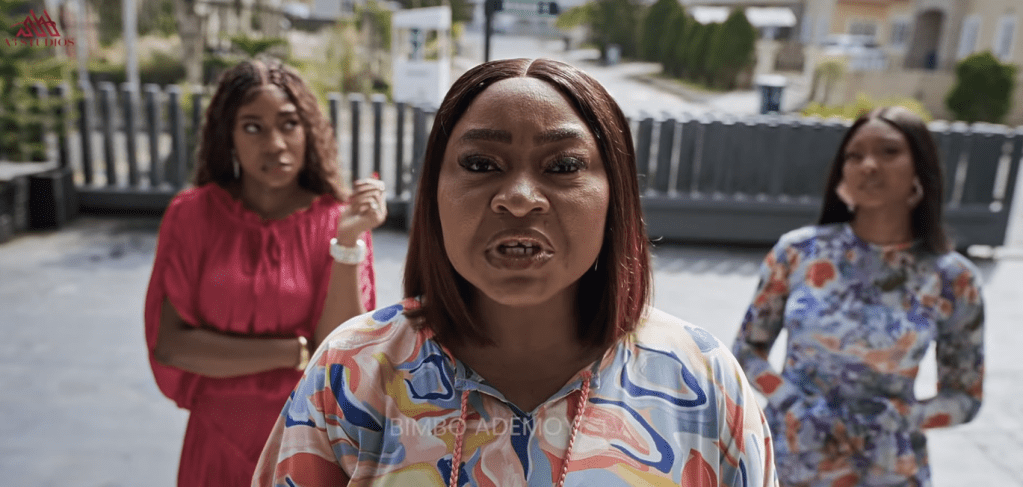
Comedy, as literary critics remind us, is not merely about laughter. As The Bedford Glossary of Critical and Literary Terms notes, while comedies evoke laughter, they often pursue serious ends. Like many comic traditions, Ademoye uses humor and glamour to expose abnormalities in elite Nigerian family life. Where Love Lives highlights crises normalized within contemporary households and underscores the necessity of self-love for healthy living. Even as it entertains, the film urges viewers to look beyond glittering masks and confront uncomfortable truths. It reminds us that the line between comedy and tragedy is thin—and that how we choose to live, and love, ultimately defines where love truly lives.


 Nollywood in Review
Leave a comment