
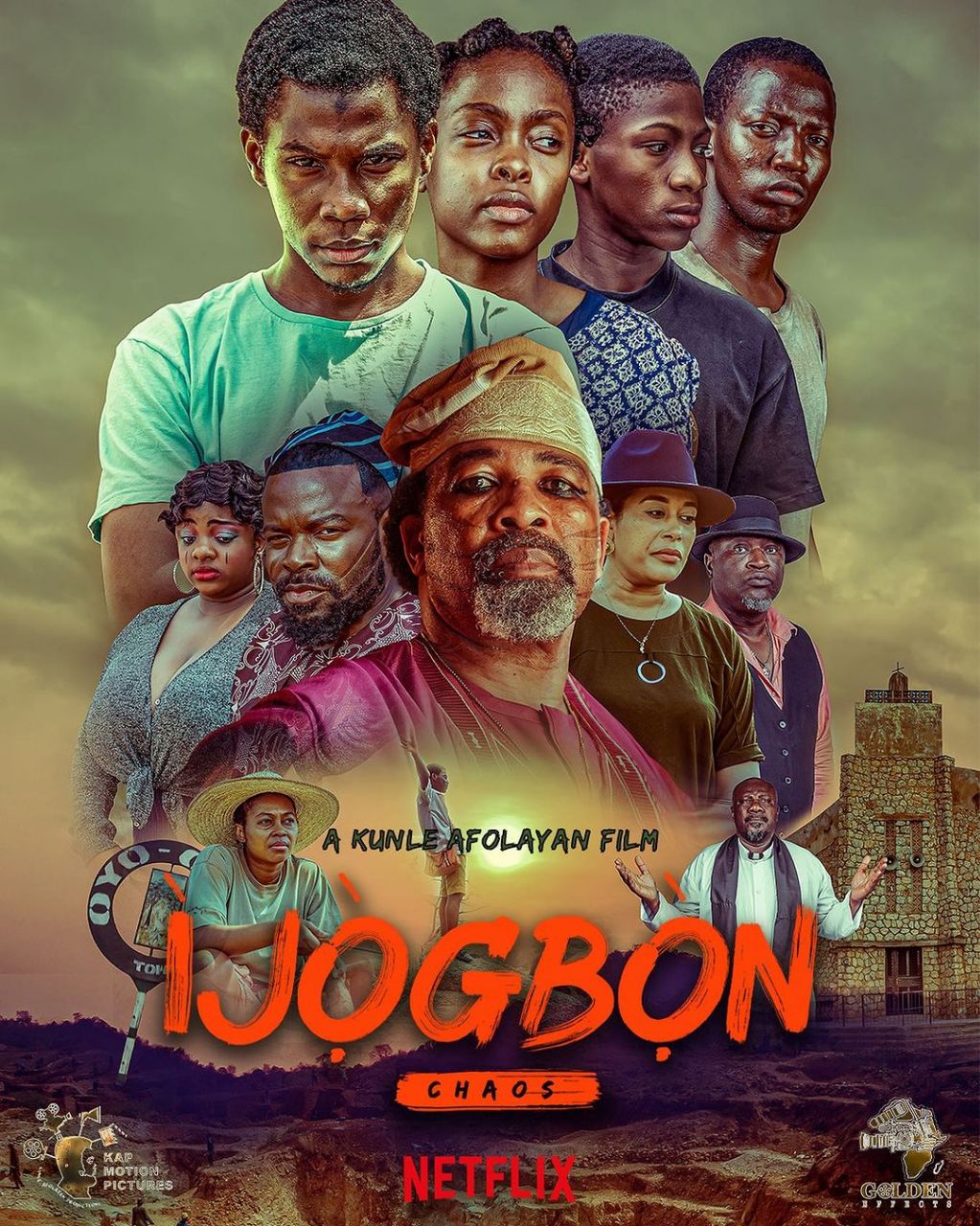
Kunle Afolayan’s recent movie, Ijogbon, has generated a lot of reactions. Many reviewers applaud it for its good storyline, others commended it for its brilliant picture quality, while one reviewer rues the missed opportunities and another frowns at the “unnecessary twists’ in the movie. The sharply contrasting responses of viewers to Ijogbon was not lost on the producer, Kunle Afolayan. While acknowledging the rights of critics to comment the movie, he was quick to point out – and rightly so – that there are different genres of movies and that movies are produced for different reasons.
Afolayan says KAP Production makes
“film for people who can think” (https://www.instagram.com/reel/Cyk_NUoredy/).
The producer’s argument is that thinking beyond the surface meaning is very important to understanding the structure and meaning of this movie. This review takes a close look at Ijogbon.
Structurally, Ijogbon borrows the traditional Yoruba storytelling method, where children around an elder in the moonlight to listen to folktales and mythical stories that teach important lessons. These legendary stories usually contain significant past incidents that can be used to navigate current realities with a view to molding the future. Some folktales are etiological stories deployed as a tool of socialization, while some are stories of war that encourage valor. Significantly, most of these traditional stories have deceptively simple structure to make them accessible to a broad spectrum of audience. But there are others that are age or gender related. Afolayan’s uses Ijogbon to tell an allegorical story that comments on the devastating effects of natural resources on Africa in general, and Nigeria in particular. But he casts it as the story of the four young Nigerians that face challenges and surmounted their challenges. That makes it a story of hope.
Ijogbon is an allegorical story; this is responsible for the deceptively simple structure. An allegorical story usually has two meanings: the literal and the metaphorical. The surface meaning tells just one side of the story. The metaphorical meaning is usually richer because it contains many layers and open to interpretation. When close attention is paid to the underlying meaning, it can yield bountiful results. But not everybody can crack the kernel and savor the juice of complex stories, as evident in the reactions of some viewers to Ijogbon. The inability to understand the allegorical bent of the movie can lead undiscerning minds to the wrong conclusion about the strength and relevance of this timely movie.
But Ijogbon is a brilliant movie. It is a modern movie that showcases the creative use of traditional storytelling method. It links the distant past with the present through the tale of the how the people of Oke Oyo lost out on their God-given resources because of greed and strive. The relationship between the past and the present is made possible with the fluid use of flashbacks and dissolves. These devices are used to connect the distant past with the present and establish causal relationships between the incidents in the mythical past and the present in significant ways. In certain areas, the folktale appears as a collage, while in others, the stories dovetail into each other in a seamless manner.
The movie opens with a panoramic view of a mining site in Oyo Oke kingdom. Laborers are seen working, with different people involved in various stages of mining activities. The bird’s eye view shots dissolve into each other, slowly giving viewers almost a holistic view of a hauntingly beautiful scenery. This is classic celebration of nature at its best. It is a beautiful picture tells the story of hope – of making it big – and the anxiety of the possibility of failure and poverty. It also tells the story of winners and losers. Lurking anxiously around and beneath the surface is the almost visible violence.
The story in the present centers around the life of four young kids: Jamiu, the son of the village teacher; Ranti, the son of the pastor, Obi, the daughter of a single mother, and Akanji, the village prince – the youngest of them all. The movie details the adventure – and misadventure of the gang of four as a means of not just showing, to use the words of Achebe, “where the rain began to beat us,” but also suggest a way out of the present predicament. In other words, these young children represent the dreams and aspirations of contemporary Nigerian society. In fact, their story become a parable for contemporary Nigerian situation. These close friends stumble on some lost diamonds that had already taken the life of many people. Rather than become the solution to their problem, it became the genesis of their disintegration, mirroring the missed opportunities of Nigeria. Because Nigerians see the discovery of natural petroleum as the route to immediate personal affluence, they abandon agriculture, jettison morality, and focus on becoming rich at all costs.
Diamond, used as a metaphor for natural resources, shows that the overindulgence in material things at the expense of morality and humanity breeds violence. It also shows that the human capacity for acquisition of materials things is native to human nature but cautions against the unbridled longing for material wealth at the expense of the community. It is noteworthy that different characters in the movie plot to own the diamond, using different tactics. They employed violence without consideration for the consequences and jettison commonsense in their quest for personal aggrandizement. The resulting violence and its consequences show that people have died, and many will still die, if Nigerians continue to blindly succumb to the animal instinct to forcefully acquire material wealth at the expense of decency and morality. The only way out, the movie suggests, is a return to reason and the restoration of humanity. This is the symbolic meaning of Oby’s (Ruby Akabueze) action towards the end of the movie.
The involvement of the four strange businessmen that visits Oyo Oke, pretending to be on a mission to establish a branch of their company in the town brings another dimension to the story. The composition of the group reflects contemporary Nigerian reality. Expectedly, the reasonable and democratic Baale welcomes them with open hands. So also, are his chiefs. The visitors comprised of Mr. Akinwowo, a ruthless guard that speaks a “strange” dialect, and a Chinese. But they are answerable to a tough woman whose face the audience are not allowed to see until later. She claims to own the diamond and would not rest until she recovers her diamond. The involvement of these group introduced an international dimension into the story.
The movie also shows the relationship between parents and their children. It is an expose of the gaps between the dreams of older generations and their scions. While the parents want their offspring to tow their line, the children have different dreams. Rather than confront their parents, they chose to be deceptive and pretend to conform, while following the path of realizing their own dreams. To the children, their parents live in the past – and they both held on to their points zealously. The introduction of religion and the contrasting attitudes of the children and parents to its dictates reflects the realistic ambiguity of Nigerians to religion. It’s another form of connection that shows the gulf separating the parents’ way of life from the children. The contrasting world views account for the different reactions of the youths and their parents. While the youths are impatient and ready to chart a different path to their dreams, the parents are the opposite; in spite of all their challenges, they place their faith in the hands of God.
The life of these kids presents an interesting and uncanny reflection of contemporary Nigerian society. To one of them, the best way to handle the season of anomy and hopelessness in the country is to JAPA. But to Jamiu (Kayode Ojuolape), is not totally convinced that leaving the country in search of unattainable greener pastures is the solution to the current problem. He attempts to persuade Oby, the strong-willed young lady among them, not to buy into the idea of traveling out at all costs. This seemingly insignificant argument between them is one of the important messages that instigated the movie. Why should Nigerians believe that travelling out in search of greener pastures even at the risk of death is better than working hard and making it in Nigeria? Why not wait and seek home-grown solution to their problems? Oby empties the diamonds into the sea, effectively ending all hopes of getting money to travel out. This singular action made in frustration shows the triumph of reason over the indulgence of JAPA and suggests a precarious hope for the future.
Kunle Afolayan’s Ijogbon is a serious story interspersed with funny episodes that help to reflect and laugh at the Nigerian situation. It is an allegorical story that showcases the current travails of Nigeria and suggests that with reason and commitment, Nigeria can overcome its current challenges. After the hugely successful Anikuloapo, it is significant that Kunle Afolayan chose the combination of traditional and modern storytelling method to address a relevant aspect of the current situation in Nigeria. Ijogbon, like Mokaliki, another interesting movie from KAP production, that refracts current Nigerian reality. The combination of experienced and new actors worked well. Even if the young actors still need to hone their acting skills, Ijogbon provided an opportunity to showcase their potentials. It is highly recommended for the general audience, especially for “people who can think.”
 Nollywood in Review
Leave a comment